Sunday, March 31, 2019

Sara: Book review (beware, it is a romance) (I know, I should read more variety but oh well)

This week, I feel all my creativity and energy in general has been taken by due dates and group presentations and also the fact that I saw my advisor to get my graduation clearance - I'm mildly super ultra scared about graduating so that was not fun. Anyways, I didn't know what topic to use for my blog post, so I'm going to review the last book I've read, which it also feels a little bit in accordance with our last class discussion.
The book is called "Falling into us", published in 2013 and written by Jasinda Wilder. It is a romance, as I warned in the blog title, and it was mind-blowingly amazing. I know most of the people in the class is not into romance, but it is the last thing I read and I thought it was one of the "good romances", so here are my thoughts. 
It is the second book of a series called "Falling", and I've also read the first book which was so so so so good too, but I actually enjoyed the second one even more, which is a feeling I love. "Falling into us" is written in a double POW from the two main characters: Becca and Jason. The story begins on their sophomore high school year, and it spans until they are on their middle twenties. Usually, I don't like books that have such a big time gap, but I think the author did an amazing job keeping the storyline cohesive and their chemistry on point. 
Becca is a shy girl, super smart and loyal, but quiet and insecure with her words because she stutters. Jason is a popular football player, and so far we see the typical high school trope with the nerdy girl and the jock, but honestly, the two of them were way more than that. She is half Italian, half Lebanese and lives in a house where her dad is super strict and protective and her brother is bipolar. Jason's dad is a police officer and is physically abusive toward his son, wanting him to be the best football player or as a consequence of failure to expect a beating. 
That's their life at home, but in a really unexpected way, they both end up having a date and they fall in love. It is really sweet, but it never reaches cheesiness - believe it or not I have DNF books that were extremely cheesy and/or had unrealistic chemistry between the characters. They are both their first's for basically all the romantic firsts you can think of, and I'm going to say that Jason was too perfect to be real. Here is when I read books with too good to be true guys and I have to tell myself this is a fictitious world, and I in no way can have book-guy standards in the world we live in. Everything between them was amazing and sweet until Jason's best friend dies right after their high school graduation. That is the first drama in the book, and I already knew that one from the first book, so I was not too shocked. I actually was impressed by the author's way to deal with it. I really approve of how Jason and Becca felt and acted, helping each other and going to therapy so they were able to move on. 
The book was super long, and with my ability of rambling I feel I've already written too much, so I'll try to wrap up my feelings and thoughts. One of the main reasons I loved the book was because all the drama was external. I'm the first one who appreciates some angst, but it can also be super exhausting. With Jason and Becca, every problem they had was something nonrelated to their personal relationship. There is a point (super big spoiler ahead) where Becca's brother commits suicide and I'm not going to lie, I cried reading that scene. The author did an amazing job portraying a person with a mental health issue, and here is where I think the romance genre can actually talk about serious matters. There was so much more in this book than just Becca and Jason's love tale. It was a coming of age story that dealt with domestic violence and mental health and figuring out what love really is. It was a really emotional novel, and even though there were really hard parts to read, I truly enjoyed it. 

Friday, March 29, 2019

Jae: Dear Sara

Dear Sara from our class,

I am currently reading the book, "The Hating Game" as you recommended to me a while ago. I am now at the part where Joshua and Lucy are at the hotel and things are getting... spicy. To be fair, they were spicy before and I think that will likely be the case in the future. I knew it was a YA romance novel, but I wasn't quite expecting it to be like this. Nevertheless, the book is really good. BUT WHY ARE THERE SO MANY SEXUAL TENSIONS/ I-HATE-HIM-SO-MUCH-THAT -I-WANT-TO-KISS-HIM trope? But thank you for recommending this book because I'm enjoying it overall. 

Best wishes, Jae LEe

Thursday, March 28, 2019

Mia: Book to Screen Adaptations

I was thinking recently about book to screen adaptations. One of my favorite book series, The Raven Cycle, is becoming a TV series. I follow the author on Twitter and she's mentioned that she is going to be apart of the script writing team. To be honest, even so, I'm terrified.

Why are book to screen adaptations notoriously so bad? I think it has a large part to do with the fact that we all probably have perfect versions of what the story should be like played out in our minds. We imagine characters in our heads and when they don't meet those expectations, we get upset (side note: I dislike when covers have pictures of the characters). On top of that, the medium of TV or movie is way different than a book. Simply writing a script is a different process from writing a book. Plus, if they were to follow everything exactly as it was written, it would probably take much longer than the time allotted.

More on the side of books, I wonder how authors view their adaptations - do they hate them? Find them funny? Regretful? Love them? Like... Rick Riordan can't be happy with those movie adaptations... Although, the money was probably good (HOWEVER, Logan Lerman is cute and pretty much exactly how I pictured Percy, so that was cool). (Also, as I'm writing this, I realized I've never looked up interviews. I'm sure they exist. I'm gonna look them up later. Anyway.) I'm sure there's a lot to do with legal and contract work, but I'm always curious as to how much every author is allowed to be in the process. How much power or say do they have? Again, I'm sure it varies from production to production, but sometimes I feel like the scripts veer so wildly off the course of the book that it can't be considered the same thing.

Book to screen adaptations are a blessing and a curse. There have always been times where I thought, "Man, I'd love to see this in movie/TV form" - hell, I've thought that about The Raven Cycle. But I have so many things I want it to get right: the atmosphere, the small town magic, the way Blue's house looks in my mind, how all of the characters dress, Blue's hair clips. And I know that my expectations can't possibly be met. Also, you know they're going to stop before they get to the fourth book and I'm sad just thinking about it. Henry Cheng deserves better. But that being said, I don't want them to introduce him before he's supposed to be in the story... And this is exactly why book to screen adaptations are hard.

Right now, I can't really think of many book to screen adaptations that I've thought were accurate. None really come to mind. It's easy to hate on them, but it's hard work converting books to movies. Personally, I like to view them as two separate entities because they are two different mediums and to be honest, it makes me enjoy it more. And just cause I'm talking about it, I prefer TV series because I think they allow for more time and detail work... Anyway... Apparently I had a lot more to say than I thought I did. I really never know how to end these posts. Enjoy the long weekend!

Wednesday, March 27, 2019

Evelyn M: A Possibly Hot Take — probably just mildly spicy

Hello, I have returned to the blog after my two week long struggle with google after they thought I was stealing my own identity and locked me out of my gmail account — so now I have a new one!

Fun fact: 3 years ago, someone in the US government made a clerical mistake and filed that my stepmother Tiffany was DEAD. So we suddenly got all of these forms to fill out and her social security number was cancelled etc., all because she was legally considered dead. Classic pranks!

Anyway, this will be a very rambling blog post on modern feminism in literature, specifically as seen through dystopian feminist books. I believe I first read The Handmaid's Tale (published in 1985) when I was about 14 or 15, and I was like HOLY MOLEY! At that point in my life, my personal introduction to women's issues/rights and feminism in general was just beginning, so reading that book was almost like an outsider looking in. I found it powerful and shocking and waved it around to anyone who would listen.

Now, however, at the ancient age of 21, I find reading books of the same vein as The Handmaid's Tale absolutely exhausting — and they just keep coming out!! From The Power, to The Women's War to The Water Cure, to VOX, all of these novels deal with gender politics in a violent and dystopian way. As a young woman, I am ACUTELY aware of how much sexism sucks each and every day and feel so TIRED when I have to read fiction about it too.

I'm tired of reading books like this!!! I think we've discussed escapism through literature before, and this type of writing to me is just the opposite. It's literally painful for me to read through yet another dystopian society (that is way too familiar to our own) of violence against women. Frankly I just have lost sight of the value that these books bring to literature. That's all I have to say, I'm gonna go watch Gilmore Girls.

Tuesday, March 26, 2019

Molly: The Worst Bestsellers Podcast

I finally got to listen to a few episodes of the podcast I chose, and I was pleasantly surprised by how much I enjoyed it. I've been living under the impression that I don't like podcasts for a while, so I was a bit apprehensive to listen to this one. The basic overview of this podcast is that they read bad books (or watch bad movies or other things) so that 'we' don't have to. And by bad books, they generally mean books that had very opposing opinions where some people loved them and others hated them.

In looking through their roster of episodes, I wanted to see what their first selection was, and they had chosen Twilight. I immediately was interested because I really love Twilight, and I know the majority of the world hates it, so I wanted to see what they had to say about it. Since it was the first episode, I don't know if it was their normal podcast format, but I also listened to another one and it was mostly similar. There are over 100 episodes on the podcast app. They didn't have advertisements, but they did talk about their Patreon pretty often (more in the later episode I listened to)

When the podcast started, I was not excited because the first person to talk hates Twilight. She used to work at a YA bookstore, so she remembers the initial surge of popularity when the books first blew up. That, on top of other reason most likely, has led her to have a negative view of the series as a whole. But then, another of the hosts (there are three total I believe? Or two and a guest?) admitted that she was Twilight fan, so I settled down. I liked the range of opinions among the hosts which helped it not be swayed in one direction for the whole time. They were all very open and weren't like, married to hating or loving it. They discussed in depth the main characters and their interactions. They also talked about the differences and similarities between the book and the movie. Their banter was really entertaining, and it was actually a conversation I wish I could have joined in on. (side note- one of the hosts had a voice that sounds exactly like a friend of mine, who would never be talking about Twilight in that much detail, or at all probably, so it was very distracting thinking it was her lol...) They gave recommendations for people who liked Twilight, including a lot of other vampire related content. At the end of the first episode, they played a game of would you rather (mostly questions about Twilight vampires vs Dracula) and gave a recommendation for a candy pairing for the book, which I found very entertaining.

The second episode I listened to was out of personal curiosity as well. It was about the movie Christian Mingle, which if you haven't seen it, please don't watch it. Or do if you want a good laugh. It's like a Hallmark Christmas movie, but worse. As a Christian I had a real good laugh though. This episode was a bit different from the first for three reasons: 1) they called it a 'bonus' episode in honor of reaching a funding goal through Patreon; 2) it was about a movie; and 3) they were all tipsy. It had a similar flow to the first episode, where they discussed the characters and plot, as well as their opinions of the movie as a whole. The combination of the ridiculousness of the movie and the Strawberr-itas consumed made for a fun time as a listener. This episode was a bit more of a collective roast than a debate.

My last thought is that I think these episodes are way too long. I am not a podcast expert, so I don't know what the norm is, but each episode was an hour long and by about 35 minutes I was ready for them to wrap it up. Despite that grumpy take, this podcast made me realize that made my original disliking of podcasts was maybe too quick of a judgement. I didn't know a lot of the other books they were talking about, but I would definitely consider getting into it more.


Jess: Book Review Panel

https://www.google.com/amp/s/www.vulture.com/amp/2018/09/brooklyn-book-festival-2018-the-most-memorable-moments.html


See details under the Mass Extinction of Book Reviews

Sebastian: Hero

https://parulsehgal.com/

Jess: The Bookstore (Podcast)

This week I listened to the Bookstore podcast. Their tag line is “it’s like book club but we actually read the book.” In hindsight, this was probably not the podcast for me because I love book clubs and that critique seems a little unnecessary. The premise is that best friends Becca and Corinne spend each week talking about a book. They used to work at an independent bookstore together, and the podcast was meant as a way to talk not just about books but also all of the book related topics that used to come up. They list some of those in their one minute trailer and they sound pretty similar to the types of questions we open class with. That said, they didn’t get to any of those types of topics (which author would you want to have dinner with, what three books would you take to a deserted island, etc.) in the episodes I listened to.

The first episode I listened to was one on Swing Time from April 23, 2018. I originally tried to start with their most recent episode on My Sister the Serial Killer, but was promptly warned that there would be spoilers. So I scrolled back a long ways to find a book I had read. On Swing Time, they made a lot of points I agreed with. For one, they talked about how surprisingly readable Zadie Smith is, despite her place as a modern literary icon. But they also had some comments I truly could not get behind. Swing Time is somewhat separated into two sections, one focused on childhood and one on adulthood. I was generally more drawn to the former, I found those stories more compelling. They both seemed to think the adulthood part was more understandable and well-written mainly because they didn’t understand one of the characters motivations at all. I’m going to try to not get to into this here, except to say that The Bookclub podcast I listened to on this book had enough dissenting opinions and nuanced conversation that they didn’t entirely miss the point. 

The way I felt about that first episode didn’t bode well for the next. I decided to listen to an episode on a book I wouldn’t read. I picked I’ll Be Gone In The Dark because I was interested but don’t have the stomach to read a book about a serial killer. I found the episode to be surprisingly upbeat. Personally, I felt they were a little bit cavalier about the experiences of the survivors, and that made me largely uncomfortable. I think the hosts have a nice rapport, but they get along so well it never feels like they take a moment to question each other and have a real conversation.

To switch gears, I listened to an episode from March 5 on what they’ve been reading and some book suggestions. Unlike the rest of the episodes, I hadn’t heard of any of the books they recommended. In true bookstore employee fashion, it seemed like they knew a lot of smaller publishers and new releases that may have flown under the radar. Their tastes range from nonfiction to poetry to short story collections, and if you’re looking for something new I think they had a great number of reads that sounded excellent. 

Would I listen to this podcast again? Probably not. But I might go back and look for the recommendations they gave in that last podcast. 

Monday, March 25, 2019

Tom - Podcast: The Librarian is In

This podcast ended up being pretty interesting. The Librarian is In is "The New York Public Library's podcast about books, culture, and what to read next." The two hosts, Gwen and Frank, have a constant back and forth conversation style that was easy to listen to. 

The first episode I listened to was called Mourning Heathcliff, Hedwig, and All the Literary Dogs. I picked this episode mainly out of my curiosity for the topic that was to be discussed, which was the effect of character death on the reader. For this episode, Gwen and Frank brought along a guest named Eric Molinsky who is the host of a podcast called Imaginary Worlds

One of the most important discussions revolved around the role of parasocial relationships, or relationships that one can have with someone that they don't actually know in real life. When you think about it, this is quite an interesting concept. Sometimes we become so connected to characters in a story, we feel as though we know them on a real-life, personal level. This was the main argument for how readers are effected by the deaths of characters that they have parasocial relationships with. The emotions elicited are vivid and impactful. An expert determined that from a psychological standpoint, readers are most likely to establish parasocial relationships with characters that display avoidant attachment styles. Due to their limited circle of friends and conservatism when it comes to trust, forming a parasocial relationship with such a character makes you feel as though you are actually one of their best or closest friends. 

Before listening to this podcast episode, I never truly pondered the reasons behind we as readers can feel such powerful emotions when a character we connect with dies. 

I also listened to the episode titled That Episode about 'Cat Person'. I was drawn to this episode since we have all individually read Cat Person, and since we have discussed it in class. I was interested to learn that many of the story's critics were conflating non-fiction with fiction as they read. 

When discussing the end of the story where Robert sends repeated and increasingly vile texts, Frank says that he felt heartbroken for Robert, although he did not approve of his actions. On the other hand, Gwen states that she felt sorry for Robert the entire time until he sent these texts. Gwen says she predicted the last line of the story, whereas Frank was caught more off guard. Personally, I was shocked when Robert sent his final text. 

One final topic of discussion had to do with the difference between the societal pressures faced by men and women today. Gwen and Frank bring up the point that women are pushed to think about other peoples feelings and emotions, even if it means doing something they don't necessarily want to do in order to preserve someone's feelings and emotions. For Margot, this involves following through with Robert when they go back to his house even though she wants to leave. Conversely, the societal pressure for men to hide and compartmentalize their emotions is discussed in the context of Robert, when he can't accept the emasculating facts about the situation he is in. 

I felt like this episode provided a solid overview and analysis of Cat Person from different perspectives.

The Librarian is In was light, engaging, and provided new insights into some ideas I have never considered deeply before. I give it a thumbs up.

Mia: Podcasts

I'll talk more about the podcast I chose tomorrow (?), but I started scrolling around my podcast app to try to find more literary podcasts to listen to. What's interesting is they're pretty hard for me to find - there's no one set genre for podcasts of this nature and I had to do some digging to find a couple (didn't really like them, also it was easier to find ones from publishing companies, which is to be expected). That being said, maybe I'm just horrible with technology (which is usually the case).

I don't usually listen to literary podcasts. I listen to a lot of D&D, comedy, and other miscellaneous shows that I can't really put into genres - stuff like My Brother, My Brother, and Me, Wonderful!, Friends at the Table, Wikicast, etc.

Anyway, if anyone listens to any kind of podcasts that they adore, I'd love to listen to more!

Sunday, March 24, 2019

Anna: Mommy Blogger Drama

I don't know what made me think about this story again, but back in January mommy blogger Christie Tate wrote a piece about how her daughter confronted her about her blog. The daughter had just gotten a laptop, and upon googling her mom's name, found dozens of written pieces detailing her experiences growing up, including potty-training and losing friendships in school, all from her mom's perspective.  She asked her mom to remove the pieces and to stop writing about her, but Tate refused to stop. I remember reading a lot of the backlash on Tate's decision to go against her daughter's wishes, albeit coming up with a few compromises, like never using her daughter's real name and asking for her veto on certain topics.

One of the choice quotes from Tate's article that makes my head spin:
Promising not to write about her anymore would mean shutting down a vital part of myself, which isn’t necessarily good for me or her. So my plan is to chart a middle course, where together we negotiate the boundaries of the stories I write and the images I include. This will entail hard conversations and compromises. But I prefer the hard work of charting the middle course to giving up altogether — an impulse that comes, in part, from the cultural pressure for mothers to be endlessly self-sacrificing on behalf of their children. As a mother, I’m not supposed to do anything that upsets my children or that makes them uncomfortable, certainly not for something as culturally devalued as my own creative labor.
Even after revisiting this, I don't know what to make of it. On one hand I would feel mortified if details of my turbulent adolescence were published online by my mom, but on the other hand Tate has made a livelihood surrounding her experiences as a mother, giving her a public platform in an otherwise very insular, sometimes isolating role. Either way, it brings the issues privacy and agency into question with situations like this.

Buzzfeed article detailing the drama

Friday, March 22, 2019

Beaks & Geeks podcast

I chose the Beaks and Geeks podcast, a podcast under Penguin Random House. Its 'tag' is "Candid conversations with authors" which seems pretty true to form based on the episode I listened to from December 2015 with guest George Saunders -- which, yeah, I chose because I like George Saunders. He was phoning in though, so it was a little weird at first to be listening to a podcast of two people having a phone conversation. It starts similarly to late-night shows, where the guest promotes what they've been working on. For Saunders at this point it was promoting his children's book The Very Persistent Gappers of Frip. After that, though, they went on to discuss the implications of the book, which is centered around the Syrian refugee crisis, and delved into national morality, etc. It's really less about the work and more about picking the brain of the author, based on this episode. Emily, the host, was a little awkward, but that's to be expected from someone whose career centers around books (no offense, professor). Early on in the podcast she said "I'm sure New York is happy to be used by you" and I could hear the regret after she said it. She also asked certain prompts like "What is your most productive time to write" or "What is your favorite place to write".

Thursday, March 21, 2019

Like this or Die response

Lorentzen starts out the article with a passage discussing consumerist culture and how "the algorithm" shapes the things that we consume. Here he raises the shadow of an interesting question: how exactly is consumerist culture and "the algorithm" affecting the identities of people who have built their lives around consumption? Lorentzen points out the ways in which consumerist interactions with culture aren't based around an enjoyment for the material, but rather the ways in which this consumption reinforces the ways we already view ourselves (I'm a busy person, I stay in the loop, etc.).

What made this confusing to me was that Lorentzen seems to veer very sharply away from this course later in the article. His focus becomes not whether or not we can genuinely interact with art through the lens of consumption, but seems to shift instead to people consuming "incorrect" books in an "incorrect" way. Lorentzen points to the ways in which book reviews have been streamlined and "dumbbed down", but he doesn't seem to consider that the ponderous, critical New York Times reviews he loves so much are also a form of consumption. It seems that Lorentzen has just as much of his identity invested in reading the "right" books the "right" way as Alex and Wendy have in watching the best TV shows all their friends enjoy. His criticism then isn't of consumerist culture and the formulation of identities around the things we consume, but rather a call for a change to a different kind of consumerism.

Sam: Emilia Clarke Article

Speaking of algorithms and things that come up on our feeds…I got sucked into reading Emilia Clarke’s essay that was published today titled a “A Battle for my Life” when it popped up on my Twitter. If you don't know her by her real name, she plays Daenerys Targaryen. Like thousands of others I love Game of Thrones, so naturally I was curious what she was writing about.

I do wonder how this article came about--if she approached The New Yorker wanting to write this piece or if they somehow approached her. She says in the article this was her first time speaking about her health struggles so I wonder why The New Yorker for avenue of choice..? Someone of her status could easily go on a talk show, do an interview, and be done with it. Was she given special editing attention in composing and revising the text? It's only been out for a few hours and the initial New Yorker tweet already has 10k+ retweets and 30k+ likes.

Fates & Furies

I realize that like all of my posts are just updates on what I'm reading but whatever. I picked up Lauren Groff's Fates & Furies yesterday and am already ... surprisingly halfway through it. As the slowest reader in the world this is really wild.

I really unashamedly was interested in it because of all the hype it got a few years ago and also because Barrack Obama said it was his favorite book of 2015 - which surprised me knowing the genre/plot/etc. Anyways I think its quite good.

Also learned that Groff writes characters and certain moments with color palettes in mind that lead her to make certain decisions tonally and whatnot which I found interesting. Like synesthesia. Literary synesthesia!!!!!

Anybody else read this before? Lmk.

xoxoxoxoxoxo

Wednesday, March 20, 2019

Molly's blog

Hi friends,

Per request of Professor Stockman, here is the link to my blog!

https://mollykauper.wordpress.com

Sorry I guess that makes y'all my side blog :/ :/

Check it out :)


Tuesday, March 19, 2019

Sebastian: PLAN FOR FRIDAY

A lot of moving pieces today! I thought I'd work to clear up a few loose ends.

On Friday, I will confab with the rest of you (at a faster clip, I hope) to talk about your project plans. 

Then we'll discuss one of my favorite topics: reviews! Book criticism: what's it even for?
Please read these:
—Jessa Crispin's "The Self-Hating Book Critic" in Literary Publishing in the 21st Century
—Christian Lorentzen's just-out Harper's piece Like This or Die: The Fate of the Book Review in the Age of the Algorithm

Supplemental:
I'll also be drawing on this piece for our discussion. But it's a little too obsessive for me to ask you to read the whole thing (I think it's literally 20,000 words).
And, just for fun, this old profile of the once-savage book reviewer Dale Peck (who stopped doing vicious reviews after publishing his own novel, I think?): The Takedown Artist


Jae: Small Question

Can a literary agent sell a script/story to other industries? I was thinking circumstances where authors write stories for stuff like video games/movies/apps/etc. I mean, I think the "Cursed Child" by J.K Rowling was originally published as a Broadway show. And how watching the Broadway show was 1000x better than actually reading the script (that's what my friend told me after she saw the show).

Final Project Prompt

https://docs.google.com/document/d/1qG2LIfZc9IRB-utLasuKy-RytyyIlfrWhE_OKxp6_HU/edit?usp=sharing

Literary Podcast lists

https://www.buzzfeed.com/kirbybeaton/podcasts-every-type-book-lover

https://electricliterature.com/diverse-literary-podcasts-books-writing-ffdd55bdf2e7

https://electricliterature.com/17-literary-podcasts-to-ease-your-commute-b9a27d8243ae

https://www.craftliterary.com/2018/02/15/literary-podcasts/

Monday, March 18, 2019

Anna: Reading habits

This is not really related to publishing as an industry, but recently I've been trying to come to terms with my reading habits and to find ways to improve the way I read. I can't pin the exact moment, but I think since high school there's definitely been a decline in the frequency, speed, and passion with which I read for pleasure. I'm not sure if it's an issue with the books I'm choosing, the location I'm reading, my time management, or my ability to focus. Often I feel guilty choosing to read a book that isn't assigned for class or not dedicating my time to working on an assignment I have due. Is this something that others feel? There have been books that I've sat down and gotten through while still juggling work and school and social life and keeping myself sane, but I feel like the stars had to align in an exact way in order for this to happen, and the ability to replicate it won't come for another few months. It gets incredibly frustrating when my list of books I want to read gets exponentially longer in comparison to the books I have the ability to complete.

So I was wondering, for those in class that read habitually, how do you do it? Is there a "zone" you have to be to hunker down into a book? Do you set aside time in your day to read something you've been looking forward to? Is there a certain chair you like to read in? Is all your free-time filled by reading, or do you have to negotiate with other hobbies and activities?

Sara: Why it can be scary to admit you like mainstream stuff?

I was going to do a blog post about my all-time favorite books, and then I started to overthink that many of my favorite books are too "mainstream" and even worthy of an eye roll. I was for five seconds even ashamed of having such an unoriginal taste. But after my brief self-pity party, I reached the conclusion that "so what?". If it makes me happy that's what matters. People nowadays try to be so original that I feel originality is getting depleted and it becomes even harder to stand out.
I used to be that type of person who judged people who liked mainstream stuff. I remember I made the typical commentary when I was 14 of "ugh, I don't understand people who like reggaeton, it has stupid lyrics and anyone could make it". Now I have to pray for that music to be played in American clubs because honestly, it is the best kind of music to dance at a party. It is upbeat, it is fun, it makes me be in a good mood. So I listen to it. There is music out there so lyrically beautiful and full of effort from the artist, and that music, of course, deserves praise, but I will keep listening to pop music, to reggaeton, or pretty much anything that makes me happy, because I can admire music that is considered original but I've reached a point in my life where my taste depends on what I genuinely enjoy, not what it is "socially acceptable". Just like me when I was 14, people will always judge, so now that I have grown and changed my mind, I can certainly advise that you might as well do whatever makes you happy, as long as it doesn't offend anyone! - that is the life motto.
I'm saying all of this because - confession time - sometimes I feel in this class like my taste is not original enough. Of course, the goal in life is to do your own thing without caring what others think of you, but that self-doubt can be stronger than you sometimes. I'm writing this to say that I reached a point where I'm trying not to care what others think because what I like should never make me feel bad or like I should lie about it, so know I'm going to talk about some books that I really like and that so many other people all around the world like as well.
One of my all-time favorite books is "The fault in our stars", and it can be so popular and so mainstream and whatever you want to call it, but when I read it years ago it made me feel so much and I loved it and now being almost 21 years old I cannot dismiss how that book shaped me at a certain point in my life, so I still consider it one of my favorite books. Is it unoriginal or annoying to say you like this book? You know what? You may think yes or no, but the whole point is that as long as you respect the opinion it is a completely irrelevant matter.
In my Goodreads profile, I have a "favs" folder and in it, I have 34 books. "The hunger games" of course is in there, I loved it so much and I'm proudly among the 3,065,041 people who gave it a 5-star rating.  In the list, there is also "Fangirl" by Rainbow Rowell, which was a light read but at the same time some parts really made me feel and empathize with the character and I thought it was amazing. It is part of the young adult genre, and my mindset will be most definitely different when I'm forty, but right now this is what I like and enjoy.
If I go book by book, this blog post will turn too tedious so I will end up by saying that I also have many romance books in my "favs" folder. I love reading them because they make me forget real-life problems, they can be either fun and light, or emotional and intense so there is always one for any mood you might have, and I also love them because I truly enjoy the lie of the perfect guy wandering around just so the perfect girl finds him or vice-versa and for them to fall in love and have a happy ending. I'm not naive enough to not recognize the extent of unrealistic perfection in those books because let's be honest, the "6 pack abs-6 feet 2"-fun-smart-nice hair-well dressed" guy is a mythological creature made up by mostly women authors, but the whole part where that amount of love might exist in real life gives me some hope in this messed up world we live in. Also, they can be hot as hell and that is always a plus.

Friday, March 15, 2019

Jess: Overdue Podcast & The Hardy Boys


With our mention of the Hardy Boys and podcasts in class today I thought I would mention some details about that publishing story via this podcast episode of Overdue.

Overdue is a bit of a "two dudes talking" podcast but I swear it works. They're billed as a comedy podcast. The premise is that one of them reads a book they've never read before and explains it to the other, rotating each week. The books are typically classics or bestsellers but they vary depending on Patreon requests. They also usually give the author and publishing history background to open the episode.

I particularly like when they talk about children's books because I love a trip down memory lane. They also do very special episodes where they read through a choose-your-own-adventure series. TBD if those are actually funny because I have only listened to them while at work under circumstances where the mere fact that I should not be laughing makes everything funnier.

If you do not feel like listening to the episode, these are some highlights:

The Hardy Boys were published under the Stratemeyer Syndicate. This was essentially a book packager run by Edward Stratemeyer who published the Nancy Drew series, The Bobbsey Twins, the Tom Swift series, and more you may not have heard of like Baseball Joe and The Y.M.C.A. Boys.

All of the series are written by several different authors who share a pseudonym who is not a real person. Frequently, a series would be published with 10 or so books all at once to see if it would take off. This set was referred to, unfortunately, as 'breeders.'

There were also a bunch of rules the books had to follow. Chapters should end mid-situation to build suspense. Books would begin with a review of the previous books in the series and end with a preview of additional books to promote them. For example, the first Hardy Boys book ends with: "They hoped another mystery would soon come there way, and one did at the House on the Cliff." The best rule is that characters were not allowed to age or marry (because sales dropped when they tried that).

Many of these books have been re-written and re-packaged to remove troubling racist stereotypes because they were concerned about declining sales. The Hardy Boys also apparently got "real cool with the law" in these re-writes. The original writer felt it was important to teach children that the American power structure was capable of being corrupt and stupid. In the sixties, the powers that be wanted to clean that up. The Hardy Boys also used to drink. They don't do that anymore.

If you just want the publishing history this is all in the first 20 minutes before the first ad break.

Thursday, March 14, 2019

Molly: Can I blog about blogging?

I haven't been reading much outside of classes lately, since as I mentioned earlier I have a love/hate relationship with reading. This leans more towards hate on a regular day. But, I do have a (separate) blog that I post on pretty regularly, so I thought maybe I could talk about that? For some background, my blog has a beauty/lifestyle focus, and I do a lot of makeup reviews. I know it's not everyone's cup of tea, but it's something I really love to talk about. 
I've been noticing something interesting lately relating to one of my posts. Last November, I did a review of an eyeshadow palette, and I mean yeah, I think my posts are good, but this particular post wasn't anything earth shattering. Somehow though, it has gotten an unusually high number of views for my specific blog, which has only been around for about 8 months. 
In 2018, this post got around 35 views, but so far in 2019, it has gotten almost 100 views. It gets a consistent 1-3 views every day, and it has been that way for most of the year. I am really confused because the palette isn't super famous or anything, and I wonder what draws people to it. I also wonder how so many people have found it? I have about 130 followers, and the majority of my makeup-related posts get 30-50 views in the first 2 weeks of posting. After that, they tend to not be as highly viewed. Hence why I'm so confused about my randomly popular one! I like what I post, but I also know it's pretty niche.
I know this isn't directly related to publishing or anything, but I think it is in the same realm somewhat because it has to do with writing, consumption of said writing, and marketing. It made me think of walking through a bookstore and picking out a book because it has a pretty cover or something. Somehow, one or two people have stumbled across my random post every day over the past 4 months, and they keep coming back. How though?? I'm a tad salty, because I have put much more work into several of the other ones lol... But I'll take the views! 
Again, not sure if this is totally relevant, but I know Prof Stockman likes tangents, and I do too!! I do way more writing than reading, so I figured that could go into my class blog content. (also maybe some self promo for my blog?? jk jk) (sorta) 

Jae: Memes

Can a publishing company publish a collection of internet memes to hold copyrights? Idk, man. It was a thought I just had at 4:00am in the morning. That's it.

Wednesday, March 13, 2019

Evelyn M: Times Piece on Girl, Wash Your Face

We previously talked about the prolific self-help book Girl, Wash Your Face, and the question Dbo brought up: Who is she talking to?

This piece from Time that expands on this type of thought and also talks about her UPCOMING SEQUAL (what more could she possibly have to say? sorry lol) called Girl, Stop Apologizing.

http://time.com/5548771/rachel-hollis-girl-stop-apologizing-interview/?xid=tcoshare

In particular the article talks about how her main audience is the same female group who tends to sell essential oils in pyramid schemes (haha).

These quotes:
"Among the revelations in her new book, for example, are that she has the word “mogul” tattooed on her wrist and that one of the ten affirmations she writes for herself every day is that she only travels first class."

"Hollis has adeptly ridden several waves in her rise to the top… the gig economy and the dawn of the Instagram age."

I can talk about the gig economy for like 10 years (go D'Amore McKim!) if you're interested, but I don't want to bore you.

What do you guys think about self-help books in general?

Tuesday, March 12, 2019

Jade: Trader Joe's and Small Independent Bookstores

Sometime this past week I stumbled upon an article about how the limited selection offered by Trader Joe's actually boosts its profits. After scrolling through my browser history on both my laptop and my phone, I unfortunately cannot find the same article. To try and summarize it's main argument, however, we as humans tend to be indecisive when faced with too many choices. If we have so many options in front of us, we end up thinking to much, wavering, and sometimes we end up walking away empty handed. Reflecting on this thought, whenever I'm online shopping I spend so much time looking at all of my options that once I've decided on a favorite item or two, I've already mentally talked myself out of spending money and thus promptly close the tabs.

This behavior may explain why I prefer the smaller of the two independent bookstores in my hometown. Assuming that the types of books they sell overlap a decent amount (though the smaller bookstore keeps The Rook in stock while the larger one does not...) perhaps it's because there is less of a selection that I can find or settle on a book both easier and quicker. This only applies, of course, when one is browsing. If I know of a certain book I want, I'd say it's more like a 25/75 split that the smaller vs. the larger bookstore will carry it. Another downside to the smaller bookstore is that because the store itself has a smaller footprint and is more cramped, it's not as pleasant of an experience side shuffling through the aisles while looking for my next read. It almost feels like a subtle, perhaps unintentional question of profit v. experience when it comes to the design of an independent bookstore. Something to consider if any of us open our own small business one day.

Evelyn M: Enjoy some Grade-A Lip Syncs

For your viewing pleasure:

From spring break:
https://www.youtube.com/watch?v=E-rorcjSCPY

From my last trip (Iceland), this one was a dialogue I did last summer and filmed with the other students on the trip :-)
https://www.youtube.com/watch?v=gGBfLiz4bPg

Hope these give you a laugh!!!!

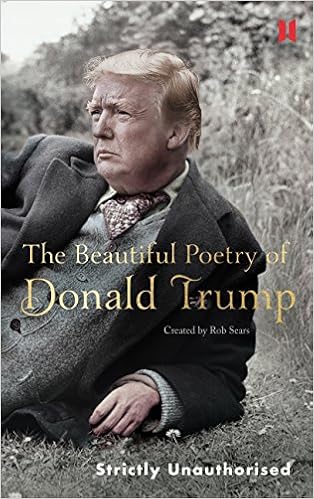
Trump the Poet


Hi guys, over break I was walking around a bookstore (Trident on Newbury St) and came across this real gem. It's a book of incredibly ironic poetry, constructed entirely of things Trump has said or tweeted. I read it for a few minutes and was thoroughly entertained. It reminded me of our is it good/does it sell conversation. I was actually surprised that this book did not seem to have any major accolades, as I think there is definitely a market for it. It seems so sellable that the question of is it good is no longer of any importance. It was "good", in the sense that it was humorous, but definitely not good in a literary sense (considering where the material came from, somehow I'm not too surprised). Honestly, I was impressed that someone came up with the idea. It seems like one of those things that, if given the right publicity or social media exposure, could be something really successful.
Also, this reminded me of our discussion of book covers. I mean, look at this. I saw the picture and then the word "poetry" and was immediately intrigued. Not a combination of topics I was expecting, and it definitely caught my eye. Anyway, it gave me a good laugh, so I thought I would share.

Monday, March 11, 2019

Megan: All Publicity is...

I went home over spring break and noticed that the book my mom was currently reading was The Woman in the Window, which we talked about with that crazy New Yorker article about Dan Mallory's lying. She mentioned it at dinner one night, to which I said that I had heard about it, and she said when she picked it up at the library, she had a conversation with another patron again about the NYer story.

So I thought about that old adage, "All publicity is good publicity," and that Mallory's infamy does seem to be getting him read. Maybe within our class some of us after reading that story agreed that we would avoid him for not wanting to support a person like that, but infamy drives interest, too. His publisher deciding to continue their contract with him definitely has landed on that side of the matter. "Will it sell," indeed.

Marisa: Podcast, The Worst Booksellers

Stumbled across this Boston based podcast, so I thought I'd share it:

 http://www.frowl.org/worstbestsellers/

The name is The Worst Booksellers, and you can find it on Spotify as well. It's a bit long but each episode is entirely focused on a popular book and they do a pretty good dissection of each in my opinion.

The last episode was on After by Anna Todd, the Harry Styles fan-fiction-turned-novel that's now also a (soon to be released) movie and definitely not something I planned to see or read, still not something I want to see or read after hearing about and wouldn't recommend.

A tangent: I now feel like I know more than I ever wanted to know about After without having read it and really can't believe this is now a book or a movie, it sounds insane - it's somewhere between 50 Shades of Grey and the infamous My immortal fanfiction which I recently found has it's own wikipedia page: https://en.wikipedia.org/wiki/My_Immortal_(fan_fiction)

 I don't know if the podcast just makes it sound crazy or if it really is but the section they read from it sounded bad, so bad that I stopped listening because it's just too cringe worthy. On another note, coincidentally the main character is interested in publishing, is magically given her dream job in publishing and it's just all very unrealistic.

Anyway, it was interesting to hear about why what exactly makes it not really "good" even though it's very popular. Overall they made some good points and enough jokes that I think I'll keep listening- the next episode is supposed to be on a James Patterson novel so that's also vaguely related to class and I'm curious to hear what they have to say.

They also have this lovely note on their about page:

"Note to authors and publicists: If you are a publicist who wants us to review your client’s book, please think twice. If you are an author whose publicist is pitching your book to Worst Bestsellers, you might want to get a new publicist. (YES, this really happens.) If you are an aspiring author who wants us to review your manuscript–we’re flattered that you think our input would be valuable, but we just don’t have the time or the expertise for that. If you’re serious about getting a non-worst book published, we recommend you pay an actual editor for manuscript review. Good luck, and we hope none of your books ever end up subjects of our podcast!"


Yaodi: Children's books as e-book proof?

I watched How to Train Your Dragon: The Hidden World recently and really enjoyed it. Since I thought that the film trilogy was so fun to watch, I got curious about the books from which it was adapted from and discovered that the books were very simple, as the words were in large font with many pages containing small cartoonish pictures.

While not what I expected, I still kind of wanted to read it, until I read some of the reviews on Amazon disparaging the e-book version of the series. Many said that the e-book is not like the typical file, where fonts and word size could be adjusted, but rather was like a PDF with only a single size per page. This makes sense on a technical standpoint since many pages contain pictures, but effectively killed what little motivational whim I had to read it since I'm too lazy to check it out from my town's local library.

While I can't see this idea being used in everything, would a viable strategy that books up to maybe the YA level be to splash small images into pages to combat the ease of e-book conversion? Or would that actually just lower the presence of readership, like it did for me? I'm also rather lazy so maybe I'm not a good barometer.

Example Review: https://www.amazon.com/gp/customer-reviews/R1HNU92YWTEYIX/ref=cm_cr_dp_d_rvw_ttl?ie=UTF8&ASIN=0316085278

Sunday, March 10, 2019

Sebastian: The Bookstore Questions

I'd like us to come out of Spring Break considering the Behemoth we've barely touched on. To that end, there have been some pieces published in just the last few days considering Amazon's impact and the corresponding yet surprising resurgence/persistence of bookstores.

As a palate cleanser, I'd like us to read in LITERARY PUBLISHING IN THE 21ST CENTURY (the gray book) two pieces: Matthew Stadler's "The Ends of the Book" and then the very next piece, Steve Wasserman's "The Amazon Effect." 

I want us to read the Stadler because of the community-fostering aspect of Pangyrus' mission that Greg Harris talked about. Some of Stadler's arguments reminded me very much of the way Greg talked about his mission.

Then, a few recent pieces from around the web:


And then, only if you have time, check out the slightly older but very good piece in The New Yorker: Cheap Words.

Sam: Reading Rampage

Since I was regretfully not on a tropical vacation over spring break, I had some ample reading time in between sleeping and working. I found myself looking for books to fill the free time, and went on a slight frenzy.

Here are the books I read over break:


A Very Large Expanse of Sea
by Tahereh Mafi

     I haven’t read YA in quite awhile, but thought I’d return for a book I’d heard a lot of hype over. I think it was one of the only books I’ve read centering on a hijabi teen in the U.S. I think the author did a really good job of cultivating her identity, and showcasing her faith as only one small part of her.

     Must say though, did not miss the cringe-worthy romance in YA and would have liked this to be LESS focused on the love interest and more focused on the protagonists really cool break dancing skills.

Is Everyone Hanging out Without Me? by Mindy Kaling

I don’t even know why I read this, except for the fact that I like The Office, and usually trashy books. That’s really all I have to say on that.

Outliers: The Story of Success by Malcolm Gladwell

This book had SUPER high ratings. I was still pretty much bored every chapter. A lot of the book is analyzing “successful” people and seeing how they got there. But, I wasn’t always convinced, and I didn’t find the writing compelling.


Educated* by Tara Westover

This was actually one I decided to start after looking at NPR’s list of books for 2018 coupled with high Goodreads scores. It’s a memoir of a woman who grew up in a Mormon community in Idaho with six other siblings and no education until college. REALLY well written and would recommend.

*Not done yet


Friday, March 8, 2019

Mia: More on Translation Because I Can, Not Necessarily Because I Should

Since Greg came and we had a wonderful conversation about translation (woo!) AND it’s break which means I can write for a lot longer (woo!), I’m back with another translation post (sorry!).

So. Translation. Lots of interesting questions about culture and the translatability of that, which got me thinking about my small knowledge of Japanese films, which now leads into this post which (sorry) doesn’t have much to do with publishing, necessarily, but I’ll try to find some roundabout way to relate it back at the end. Or, most likely, not. 

Anyway, let’s talk about the famous animated film, 君の名は (Kimi no na wa) or the English title, Your Name. This is more for me to talk about some fun translation things, rather than anything else.

One of my favorite things to talk about is the title. The title in Japanese, is literally translated to, “What is your name?”. However, there’s a bit more to it than that. In Japanese there are different levels of speaking with familiarity. “Kimi” means “you”, but it’s a type of saying “you” that you would only use with close family and friends. The title is intimately asking what someone’s name is, however, if you were using “kimi”, you would already be well acquainted with that person. This perfectly encapsulates the plot and theme of the movie which I won’t go into because spoilers… also this post is about to be long already. But it’s so cool, right?!! There’s a certain kind of social complexity cannot simply be captured in “what is your name?”, because we do not have levels of formality in English that we commonly use.

Also in the movie is this great joke that is hard to translate into English. As I said above, there are different ways of saying “you”, so likewise, there are different ways of saying “I”. The protagonist (a woman who has been switched into a man’s body - it makes sense, I swear), slips up and uses different kinds of “I”, confusing the boy’s friends, until she settles on the right one. She goes from using “watakushi” (very formal), to “watashi” (somewhat formal?), to “boku” (informal, used specifically by young boys), to “ore” (informal, used specifically by older boys). I was curious about how they they translated it, so I searched and found a clip with both the Japanese version and the English dubbed version.


Speaking a little more to the Japanese language because I find it fascinating, the different levels of formalities in speaking express more (to some extent) than I think we could in English. In some ways, you can use language to gauge how close people are, just through conjugation. Slowly transitioning from speaking in formal Japanese to informal Japanese marks a shift in relationship - how much someone respects another person is implicit more or less in the level of formality that they use. It feels more like a social subtext, than something outwardly said.

All of this to say that perfectly translating not only language but societal contexts, issues, norms, etc. is not possible. I was thinking about this while Greg was answering a question about translating cultural norms. Would it be best to just put a footnote? Or let the reader have questions and then look into it more on their own time? Or try to change the story to fit our own societal ideals and concepts? (That last one doesn’t feel particularly ethically correct to me). Anyway, I’m gonna wrap this up since this post is long and I already cut a whole paragraph on Shall We Dance? because it was redundant but I just like talking about this kind of stuff. Thanks for getting this far and reading my ramblings!

Wednesday, March 6, 2019

Sara: Thinking of how publishing works while traveling

For this spring break, I came to San Francisco to visit a friend and explore the city. On Monday, I had to do some solo tourism, and I ended up walking around with no real direction. That is one of my favorite feelings, being in a new city and having that need to soak up every little corner that is full of the unknown. Around 4 pm that day, I found myself walking down a nice street that went straight to that pointy building that is really characteristic of the SF skyline - I just looked up the name of the building, and it is called the Transamerica Pyramid! Suddenly, I see this really cool bookstore and I just had to enter and explore. It looked unique and just like a place where you can lose yourself in books. I had two hours to kill, so I spent at least one hour just looking at the books, admiring covers and trying to restrain the need to buy at least 20 of them.
The place is called City Lights, and it is a bookstore and independent publisher! How amazing is that?! I thought it was a delightful coincidence and made me think of our discussions from class. Something that before this class would have had no real significance for me now is something that makes me think beyond the final product that is the book and appreciate the publication process that is way more intricate than I imagined.
I ended up buying a book and I'm not going to lie, the first thing that made me go for it to read what it is about was the cover. The book is called "All my puny sorrows" by a Canadian writer called Miriam Toews. I thought the cover of the book looked cute so I picked it up and read the blurb. It is about two sisters, one who seems to have a perfect life and the other is struggling one day after the other, but the put together sister wants to end her own life. It caught my interest, and also I wanted my choice to be as random as possible. I didn't want to check Goodreads until after buying whatever book I decided to buy, and here I am, looking forward to starting my new acquisition. Covers are so important, and after watching the TED talk by the cover designer men, I'm appreciating more and more how some covers are designed to be the perfect representation for the story inside the pages.
The whole experience was lovely, and I cannot deny that in a Barnes & Nobles it would not have been the same. Bookstores like this remind me how amazing it is that humans translate emotions into words and anyone around the world can read them and feel less alone knowing someone somewhere is feeling the same way. It is an art, and I don't mind sounding cheesy, but I think art makes this whole experience of living on Earth so much worth it.
Anyways, I had an amazing day and the unexpected trip to the City Lights bookstore made it memorable. I hope the book is good, and if not at least it will look amazing in my bookshelf and it will always remind me of my amazing trip to SF!
Hope whoever is reading this had an amazing spring break full of awesome memories too!


Tuesday, March 5, 2019

Peter Ganovsky: whore.

Hello everyone,

Sorry for posting again but I am trying to catch up on posts lol and this is kind of interesting. Was reading this little David Sedaris thing on The Guardian and found the last line particularly familiar... I have attached the link to the Sedaris piece as well as the link to Cat Person. Check it out. Thoughts welcome.

-Peter

https://www.theguardian.com/lifeandstyle/2014/aug/23/the-one-that-got-away-david-sedaris

https://www.newyorker.com/magazine/2017/12/11/cat-person

Saturday, March 2, 2019

Peter: confession

I have finally decided to bite the bullet this weekend and read the book I always lie about having read in order to avoid the mockery I receive each time upon admission from family and friends, peers and professors alike: "Lord of the Flies". Thank you.

Friday, March 1, 2019

a literary commute

Hello hello. How’s everybody doing? I’m currently riding the green line inbound from Boston College, so I thought maybe I’d make this week’s post about commutes, and reading on them. I’m not a regular commuter anymore, but for 6 monhs last spring I took the commuter rail to and from Pawtucket, RI every day. And although catching the train at 6:30 AM Monday-Friday was an adjustement, I came to love my commute for the time it gave me (forced me) to read. There are a lot of variables in the commuter’s reading schedule. Did I brave a heavier bag to bring a book I want to read? Am I rereading for comfort or reading something new for the ~excitement~? It is something artsy that I’m not afraid to hold in my hand or is it something trashy that was free on iBooks that I turn my brightness all the way down to read? Did I nab a perfectly isolated corner seat or do I have to balance precariously around one woman’s five suitcases? Is it a game day of any kind? Because if it IS a game day of any kind, there will be several townie teenagers sipping vodka from their plastic Dunkin cups and cheering every 10 or so minutes (Kind of like professor Stockman! ((If the vodka was seltzer (((And if he cheered more ((((And if he was a 15 year old named Patrick from western Mass who loved the Bruins)))). I did manage to read a number of good books in those 6 months — Decreation (Anne Carson) What The Family Needed (Steven Amsterdam), When My Brother was an Aztec (Natalie Diaz), and, um... others? All my commute memories  blur together in one conglomerate tour of small-town Rhode Island. Get this: in Rhode Island, across from the Hasbro HQ (the biggest toy/game conpany in the world) were not one, but TWO funeral homes. Right next to each other. I’m buying the rights and writing a pilot. There were also several tattoo shops (with big signs that just said TATTOO) which makes you wonder who’s getting a tattoo in Pawtucket, RI. Commuting through Allston is soo much more boring. It’s just ten million BU students and two old ladies. Maybe I’ll read for class (haha*). This has been a piece on commuting and Rhode Island. Tune in next week when I make up for not doing anything last week!


*I won’t.

Tom - Self Publishing vs. Traditional Publishing and the future role of AI

Just thought I'd post some of my inquiry ideas up here. I've been considering what I would like to further research, and I think I have narrowed it down to two main topics. Firstly, I think it would be interesting to research the benefits and drawbacks of self publishing with respect to traditional publishing. The world seems to become more digitally focused with each passing day, and although the technological takeover of publishing has been incorrectly predicted before, it is still possible that a combination of self publishing and e-sales could drive technologically based publishing solutions to become the norm.

I am also very interested in researching the role of artificial intelligence in the publishing space. I would like to determine in what ways AI is being used now, which I suspect may be primarily to serve book advertisements to internet users. I would also like to explore the idea of AI vs. Editors. Could AI one day come close to providing the same quality editing as a human editor? Do there already exist AIs that could provide editing services? I personally believe that the human element would never be able to be fully replaced, but I think AI could come very close. At the very least, it could be used as a tool offering editors suggestions and providing them more editing power. As a tool in the editor's toolbox, AI could change the publishing world forever.